Wi-Fi vs Non-Wi-Fi Baby Monitor: Which Should You Choose? (November 2026)
Choose a Wi-Fi monitor for remote app access, or a non-Wi-Fi monitor for a private direct connection and dedicated screen. Your choice depends on where you monitor, how much setup you want, and which privacy tradeoffs you accept.
On this page (9 sections)
- Wi-Fi vs non-Wi-Fi baby monitor: what is the main difference?
- When is a Wi-Fi baby monitor the better choice?
- When is a non-Wi-Fi baby monitor the better choice?
- Which connection is more private?
- Which baby monitor is easiest to set up?
- Which non-Wi-Fi baby monitor fits your needs?
- How do range and connection reliability compare?
- What should you choose for privacy and daily use?
- Which baby monitor should you choose?
Choose a Wi-Fi monitor for remote access, or a non-Wi-Fi monitor for a private direct connection and dedicated receiver. The wifi vs non wifi baby monitor decision comes down to whether you need to check in away from home or prefer a simple local link.
Wi-Fi models usually send video through your home network and may support phone apps. Non-Wi-Fi models connect the camera directly to a parent unit, so they avoid app setup, cloud accounts and internet outages.
This comparison focuses on remote access, connection privacy, range, battery use, setup and everyday nursery routines. We checked the features of 4 non-Wi-Fi options for different monitoring needs.

Wi-Fi vs non-Wi-Fi baby monitor: what is the main difference?
Wi-Fi monitors use your network for app access, while non-Wi-Fi monitors send audio or video directly to a dedicated receiver. That basic connection choice affects privacy, convenience and how you monitor from room to room.
A Wi-Fi baby monitor can be useful when you are at work, traveling or away from the house. For a specific Wi-Fi camera, read our Nanit Pro baby monitor review.
You may be able to open an app and check the nursery, depending on the model and its internet service.
A non-Wi-Fi baby monitor is designed for local viewing. The camera and parent unit communicate directly, so you can monitor from the receiver without logging in or keeping a phone nearby.
The VTech Audio Baby Monitor uses DECT 6.0 and an encrypted FHSS channel shared between the baby unit and parent unit. It has no internet, cloud account or app, which keeps the setup focused on sound.
The HelloBaby and VTech video models use 2.4GHz FHSS connections. Their cameras send video to their included screens rather than to a home Wi-Fi network.
When is a Wi-Fi baby monitor the better choice?
A Wi-Fi baby monitor is the better choice when you need remote access outside the home. It can suit parents who want to check the nursery from work, travel or another location with internet access.
Remote viewing can also reduce the number of devices you carry. Your phone may be the screen, although that can compete with calls, notifications and other daily use.
Wi-Fi access comes with more setup. You may need an app, a home network connection, an account and a stable internet link before the monitor is ready.
The same features that make remote access possible can create more privacy decisions. Use a strong unique password, keep the app updated and enable available account security controls.
A Wi-Fi model may not be ideal if you want a dedicated screen beside your bed or if your nursery has unreliable internet. Ask whether you would truly use remote access before paying for a feature that adds setup.
If you are still deciding whether monitoring fits your home, read do you need a baby monitor before comparing connection types.
When is a non-Wi-Fi baby monitor the better choice?
A non-Wi-Fi baby monitor is the better choice when you want local monitoring without an app or internet connection. It works well for overnight use, grandparents, travel and homes where a direct receiver is easier than phone-based access.
The main benefit is independence from your router. A Wi-Fi outage does not interrupt the direct camera-to-screen or baby-unit-to-parent-unit link.
Privacy is another reason to choose non-Wi-Fi. These models do not send the monitor feed through a cloud account or home network, although the exact security method still varies by product.
A dedicated receiver also keeps the monitoring task separate from your phone. You can leave the screen on a bedside table or carry it around while keeping your phone available for other needs.
The tradeoff is limited remote access. A non-Wi-Fi monitor generally works within its stated range, not from a different city or workplace.
For more privacy-focused choices, our guide to a low emf baby monitor covers lower wireless emissions as a separate buying concern.
Which connection is more private?
Non-Wi-Fi models offer a simpler privacy path because they avoid internet, cloud and account access. That does not make every model identical, so check whether the monitor uses DECT, FHSS or another direct wireless method.
The VTech Audio Baby Monitor uses DECT 6.0 digital transmission and an encrypted FHSS channel. Its direct connection is designed for audio without internet access.
The HelloBaby HB6550 models use 2.4GHz FHSS technology and digital encryption. Their cameras and screens connect directly, so the video feed does not depend on your home Wi-Fi.
The VTech VM819 uses encrypted 2.4GHz FHSS technology between the camera and parent unit. It also avoids Wi-Fi, the internet and cloud connections.
Wi-Fi security depends on more than the camera itself. Your router, account password, app permissions and software updates all affect the overall setup.
No connection type removes the need for sensible placement. Keep the parent unit and phone account private, and follow the instructions for camera pairing and mounting.
Which baby monitor is easiest to set up?
Non-Wi-Fi monitors are usually easier to start because they avoid app, account and network configuration. The included camera and receiver can often be powered on and paired directly.
The VTech Audio Baby Monitor is designed to connect automatically in under 60 seconds. It has a single up/down volume button and no pairing screens.
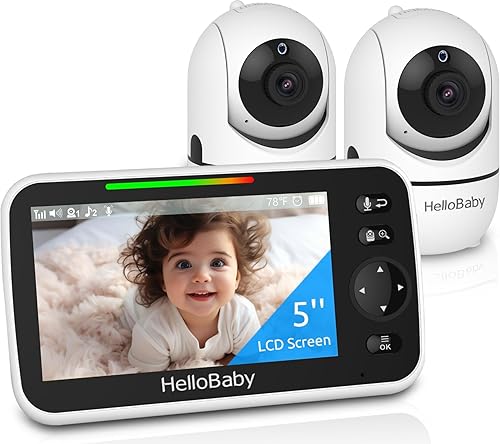
The HelloBaby No WiFi Baby Monitor 2 Cameras includes 2 cameras, a 5 in wireless screen and 3 AC chargers. The cameras come pre-connected, and the system supports up to 4 cameras.
The single-camera HelloBaby model includes a 5 in IPS screen, a plug-in camera, 2 power adapters and wall-mount screws. It is a practical choice when you want video without adding a second camera.
The VTech VM819 includes a parent unit, baby unit, 2 AC adapters and a quick start guide. Its camera and parent unit pair automatically through the direct FHSS connection.
Wi-Fi monitors may still be simple after setup, but the first connection can involve downloading an app, creating an account and entering network details. If another caregiver will use the monitor, a dedicated receiver may be easier to share.
Which non-Wi-Fi baby monitor fits your needs?
Choose audio when sound is enough, 2 cameras for 2 rooms, a single camera for portability, and the VTech VM819 for longer video monitoring. These products cover different versions of the non-Wi-Fi choice.
Best for simple audio: VTech Audio Baby Monitor
The VTech Audio Baby Monitor is an audio-only DECT monitor with an 8-hour rechargeable battery, belt clip, 1,000 ft range and 5-level sound indicator. Its parent unit can mute the speaker while the LEDs show sound activity.
It suits a parent who wants to hear movement without watching a screen. The baby unit and parent unit link automatically, and the included AAA batteries provide backup power when charging is not convenient.
The audio-only design keeps the receiver small and focused. You will not get a video view, but you also avoid screen brightness and camera positioning decisions.
Best for 2-room viewing: HelloBaby No WiFi Baby Monitor 2 Cameras
The HelloBaby No WiFi Baby Monitor 2 Cameras includes 2 cameras and a 5 in IPS screen. It uses a private 2.4GHz FHSS link, supports single-view switching between rooms and can expand to up to 4 cameras.
It suits twins, siblings or a nursery where you want to watch 2 rooms from one screen. The cameras offer remote 355° pan, 120° tilt and zoom, while the screen can run up to 30 hours in ECO mode.
The system uses single-view switching rather than split-screen viewing. That gives you one larger camera view at a time, but you must switch cameras when you want to check the other room.
Best for travel video: HelloBaby No WiFi Baby Monitor Camera
The HelloBaby No WiFi Baby Monitor Camera pairs one plug-in camera with a 5 in IPS screen. It adds 355° horizontal pan, 120° vertical tilt, 2x zoom, night vision, 2-way audio and a 30-hour screen battery.
It fits travel or a single nursery where you want video without a Wi-Fi login. The camera supports tabletop or wall mounting, while the direct 2.4GHz FHSS connection keeps the screen independent from the home network.
The camera needs power, so plan for an outlet near the crib or sleep space. The screen's battery helps you move around, but the camera itself remains a plug-in unit.
Best for overnight video: VTech Baby Monitor No WiFi
The VTech Baby Monitor No WiFi uses encrypted 2.4GHz FHSS and includes a 2.8 in LCD, infrared night vision, 2x digital zoom and a 1,000 ft range. Its 2,600mAh battery provides up to 19 hours of video or up to 29 hours of audio-only monitoring.
It suits overnight monitoring when you want video plus sound-activated screen mode. The screen can stay dark while the nursery is quiet, then turn on when the adjustable VOX setting detects sound.
The camera also includes a temperature sensor, 2-way talk, 2 lullabies and 2 ambient sounds. These features add nursery information and soothing options without requiring an app.
How do range and connection reliability compare?
The stated range matters only when the signal can travel through your home's walls and layout. A 1,000 ft outdoor figure does not guarantee the same distance indoors.
The VTech audio monitor lists a 1,000 ft maximum talking range. The HelloBaby 2-camera model lists up to 1,000 ft outdoors with its antenna extended, and the VTech VM819 also lists a 1,000 ft range.
Walls, floors, metal objects and nearby wireless devices can reduce practical range. Place the parent unit where you normally spend time, then check the connection before relying on it overnight.
A Wi-Fi monitor's reach depends on your router and internet connection. It may work across town through an app, but local nursery performance still depends on signal strength near the camera.
Use any out-of-range alert when available. The VTech audio model includes an out-of-range alert, while a Wi-Fi monitor may notify you through its app when the connection or service changes.
What should you choose for privacy and daily use?
Choose non-Wi-Fi if a private local connection and dedicated screen are your priorities; choose Wi-Fi if remote access is essential. Neither choice is automatically right for every family.
For audio-only monitoring, the VTech Audio Baby Monitor is the simplest fit. It avoids a camera and screen while adding sound LEDs, a belt clip and a rechargeable parent unit.
For video in one room, the HelloBaby single-camera model gives you pan, tilt, zoom and night vision on a 5 in screen. For 2 rooms, the 2-camera HelloBaby model gives you one screen with camera switching.
For longer overnight video, the VTech VM819 combines a dedicated screen, 19-hour video battery and sound-activated viewing. It is a stronger match when you want video but do not want Wi-Fi.
A Wi-Fi model deserves a place on your shortlist only when remote checking changes how you care for your baby. If you mainly monitor from nearby rooms, a non-Wi-Fi model may give you fewer setup steps and fewer network variables.
Which baby monitor should you choose?
Pick Wi-Fi for remote app access, and pick non-Wi-Fi for direct local monitoring with a dedicated receiver. For non-Wi-Fi choices, select the VTech Audio Baby Monitor for sound, the HelloBaby 2-camera system for 2 rooms, the single-camera HelloBaby for portable video, or the VTech VM819 for long overnight video.
Think about your normal monitoring distance before comparing extra features. A monitor that matches your routine is more useful than one with remote access or camera controls you rarely use.
If you already use a monitor, read when to stop using a baby monitor for guidance on changing your nursery routine. For a broader feature comparison, see our best baby monitor system guide.
Frequently asked questions
Is a Wi-Fi or non-Wi-Fi baby monitor better?
A non-Wi-Fi baby monitor is better for a direct private connection, simple setup and use with a dedicated parent unit. A Wi-Fi monitor is better when you need to check the nursery from outside the home through an app.
Choose based on access needs first, then compare privacy, internet dependence and battery use.
Can a non-Wi-Fi baby monitor be hacked?
No wireless monitor should be treated as impossible to attack, but these non-Wi-Fi models use direct DECT or encrypted FHSS connections instead of your home internet. They don't use an app, cloud account or Wi-Fi network.
That reduces internet-related exposure, but you should still keep the parent unit private.
Do Wi-Fi baby monitors work without internet?
A Wi-Fi baby monitor usually needs a working home network for remote app access, alerts and cloud features. If the internet or router fails, some models may keep local functions, but that depends on the exact design.
A non-Wi-Fi monitor avoids this dependency by linking the camera directly to its parent unit.
What is the best non-Wi-Fi baby monitor?
The best non-Wi-Fi baby monitor depends on what you need to see and hear. The VTech Audio Baby Monitor suits audio-only use, the HelloBaby 2-camera model covers 2 rooms, the single-camera HelloBaby adds portable video, and the VTech VM819 combines video, sound activation and a long battery.


