8 Best Baby Monitors Without Wi-Fi (November 2026)
The best baby monitors without Wi-Fi include the VTech Audio Baby Monitor for simple audio monitoring, the Infant Optics DXR-8 PRO for adjustable camera views, and the HelloBaby No WiFi Baby Monitor Camera for flexible room coverage.
On this page (7 sections)
- Which baby monitor without Wi-Fi is best for most families?
- The best non-Wi-Fi baby monitors for different needs
- Should you choose audio or video?
- How does a non-Wi-Fi baby monitor connect?
- What should you check before buying?
- How should you set up and care for a direct-connect monitor?
- Which baby monitor without Wi-Fi should you buy?
The best baby monitor without Wi-Fi for most families is the VTech VM819, with private FHSS video, night vision, sound activation, temperature alerts and up to 19 hours of video battery life. Choose the Infant Optics DXR-8 PRO for lens flexibility, or the VTech DM111 for clear audio without a camera.
A direct-connect monitor can be a good fit if you don't want a camera on your home network. For a Wi-Fi-based alternative, see our Nanit Pro monitor review.
These models use DECT or FHSS signals between the baby unit and a dedicated parent unit, so they don't depend on Wi-Fi, cloud access or a phone app. Compare Wi-Fi and non-Wi-Fi baby monitors to weigh the connection options.
If you need help comparing complete setups, start with our guide to the best baby monitor system. For camera-focused options, see our broader list of best baby monitors with camera.
Our picks at a glance
-
1

-
2
-
3
 Best for flexible room coverage
HelloBaby No WiFi Baby Monitor Camera
9.5/10 our score
See it on Amazon
- 4
 Best for overnight videoCheck it
- 5
 Check it
Motorola Nursery Audio Baby Monitor
Best for portable DECT audio - 6
 Check it
HelloBaby 6'' No WiFi Video Baby Monitor
Best for a large screen - 7
 Check it
VTimes Baby Monitor with Camera and Audio
Best for travel-friendly video - 8
 Check it
Motorola Nursery Audio Baby Monitor
Best for long-range travel audio
Which baby monitor without Wi-Fi is best for most families?
The VTech VM819 is the strongest all-around video choice for most families. It combines private FHSS video, night vision, sound activation and a long battery in one direct-connect system.
The VTech DM111 is better when you only need sound. It keeps the setup light and simple, with no camera to position and no screen to watch through the night.
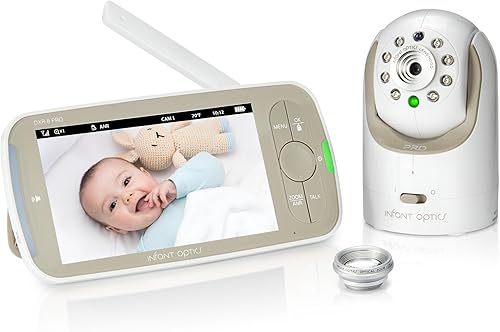
The Infant Optics DXR-8 PRO is the most flexible camera pick in this group. It supports pan, tilt, zoom and interchangeable lenses, so you can change the view without changing the whole system.
We compared the stated connection types, battery details, range, camera controls, audio features and setup needs. The score weighs those specs and features against what you are likely to use at home.
For many parents, the VM819 sits in the middle of that balance. It gives you a visual check at night while keeping the connection private and direct.
The DM111 suits a different kind of night. If your main concern is hearing your baby clearly, an audio monitor can feel calmer and easier to move around.
The DXR-8 PRO suits parents who care about framing. A fixed view is fine for one crib, but remote movement helps when a baby moves across the sleep space.
The HelloBaby models add reach and expansion choices. They are useful if you may add a second room later, while the VTimes and Motorola audio models focus on portability.
The main trade-off is reach versus detail. Audio monitors are lighter and simpler, and they do not need a clear camera angle in the nursery.
Video monitors give you night vision and a visual check without entering the room. That detail comes with more setup, since the camera needs power and a stable position.
Battery claims also need context. A parent unit may run for many hours, but most cameras still need to stay plugged in.
Range claims are usually measured in open areas. Walls, floors and furniture can make the real distance shorter inside a home.
That is why home testing matters. Walk through the rooms where you will actually use the parent unit before you rely on it overnight.
If you want video with the least fuss, start with the VM819. If you want sound only, the DM111 is a cleaner fit.
If camera control matters most, look closely at the DXR-8 PRO. Its lens options are the main reason it stands out here.
| Product | Best for | Connection | Range | Battery | Our score |
|---|---|---|---|---|---|
| VTech Audio Baby Monitor | simple audio monitoring | DECT 6.0, no Wi-Fi | Up to 1,000 ft | Up to 8 hours; 2 AAA batteries included as backup | 9.7 |
| Infant Optics DXR-8 PRO | adjustable camera views | Private 2nd generation FHSS, no Wi-Fi | 9.6 | ||
| HelloBaby No WiFi Baby Monitor Camera | flexible room coverage | Encrypted 2.4GHz FHSS, no Wi-Fi | Up to 30 hours | 9.5 | |
| VTech Baby Monitor No WiFi | overnight video | Encrypted 2.4GHz FHSS, no Wi-Fi | Up to 19 hours of video or 29 hours of audio | 9.4 | |
| Motorola Nursery Audio Baby Monitor | portable DECT audio | DECT, no Wi-Fi | Up to 1,000 ft | 9.3 | |
| HelloBaby 6'' No WiFi Video Baby Monitor | a large screen | Secure 2.4GHz FHSS, no Wi-Fi | Up to 305 m | 16 to 30 hours | 9.2 |
| VTimes Baby Monitor with Camera and Audio | travel-friendly video | Encrypted 2.4GHz FHSS, no Wi-Fi | 9.1 | ||
| Motorola Nursery Audio Baby Monitor | long-range travel audio | DECT 6.0, no Wi-Fi | Up to 1,500 ft | Up to 10 hours; 4 AAA batteries included | 8.9 |
The best non-Wi-Fi baby monitors for different needs
The best choice depends on whether you need audio, video, a large screen, a long battery or a camera that can change views. The products below are ordered by score, with the most broadly useful picks first.
VTech Audio Baby Monitor: Best for simple audio monitoring
- DECT 6.0 digital audio
- 1,000 ft range
- Up to 8-hour rechargeable battery
- 5-level sound indicator
The DM111 keeps monitoring simple with clear DECT audio, a belt clip, sound LEDs and automatic pairing. It suits parents who want sound alerts without a camera or app.
Pros
- Simple automatic setup
- Belt clip for portable use
- 5-level visual sound indicator
Cons
- Audio only
- No video or night vision
The VTech Audio Baby Monitor is the simplest option in this roundup. Its DECT 6.0 connection is designed to stay quiet until your baby makes a sound.
That silence matters in daily use. It helps avoid the constant background hiss common with older analog monitors, so stirring and crying stand out more clearly.
The parent unit offers up to 8 hours of rechargeable battery life and has a belt clip for moving around the house, yard or garage. The stated range is up to 1,000 ft, although walls and other obstructions can reduce usable distance.
The 5-level sound indicator lets you mute the speaker while still watching the nursery's sound level. One light means quiet, while five lights indicate louder sound activity.
This is a strong fit if you do not need video, night vision or camera movement. The automatic connection and single volume control also make it easy to hand to a grandparent or pack for travel.
Infant Optics DXR-8 PRO: Best for adjustable camera views
- 5 in HD video
- Active Noise Reduction
- Pan, tilt and zoom
- Interchangeable standard and optical zoom lenses
The DXR-8 PRO gives parents more control over the view with pan, tilt, zoom and interchangeable lenses. Its private direct connection and noise reduction suit families who want video without internet access.
Pros
- Interchangeable lenses
- Active Noise Reduction
- User-replaceable battery
Cons
- Wide-angle lens sold separately
- Heavier than some compact monitors
The Infant Optics DXR-8 PRO is the best fit for parents who want more control over the camera view. Its 5 in HD video monitor supports remote pan, tilt and zoom, and it includes standard and optical zoom lenses.
The private 2nd generation FHSS connection does not use Wi-Fi, an app or a cloud account. Its Active Noise Reduction is designed to filter steady sounds from fans, air purifiers, heaters and air conditioners.
The monitor includes a user-replaceable rechargeable battery, which can help preserve portability over time. The camera also has infrared night vision for viewing the nursery in darkness.
The included optical zoom lens suits close views, while the wide-angle lens is sold separately. Consider this model if camera framing matters more than having the largest screen.
For a brand comparison, read our guide to the best VTech non-Wi-Fi baby monitor. It focuses on VTech models for parents who want a direct connection and familiar controls.
HelloBaby No WiFi Baby Monitor Camera: Best for flexible room coverage
- 5 in color display
- 355° pan and 120° tilt
- 2x zoom
- Up to 4-camera expansion
The HelloBaby HB6550 gives you a broad remote camera view, night vision and a long-running parent screen. It fits parents who want a video baby monitor no Wi-Fi with room to add cameras.
Pros
- Long battery life
- Remote pan and tilt
- Supports up to 4 cameras
Cons
- Camera needs a power connection
- HB6550 camera compatibility varies by version
The HelloBaby No WiFi Baby Monitor Camera gives you a broad remote view with a 5 in color display. Its camera can pan 355° horizontally and tilt 120° vertically, with 2x zoom for closer checks.
That movement is helpful when a baby rolls or moves away from the center of the crib. You can adjust the view from the parent unit instead of going into the room to reposition the camera.
The HB6550 uses encrypted 2.4GHz FHSS technology and includes infrared night vision, two-way audio, room temperature monitoring and 8 lullabies. Its audio-only mode can help conserve battery when you do not need the screen.
The parent unit battery is rated for up to 30 hours. The camera needs to plug in, while the screen is wireless, so plan the camera position near a power outlet.
This model can expand to up to 4 cameras, but compatibility depends on the HB6550 version. Confirm the camera family before adding another unit.
VTech Baby Monitor No WiFi: Best for overnight video
- Up to 19 hours of video battery
- 1,000 ft range
- Automatic infrared night vision
- Temperature sensor
The VTech VM819 is a strong overnight choice because its parent unit can run up to 19 hours with video or 29 hours in audio-only mode. Sound activation, temperature alerts and direct video keep daily use straightforward.
Pros
- Long video battery life
- Sound-activated screen
- Two-way talk and lullabies
Cons
- Smaller screen than some picks
- Indoor use only
The VTech Baby Monitor No WiFi is the best overnight video choice because its 2,600mAh rechargeable battery supports up to 19 hours of video or 29 hours of audio-only monitoring. That gives you more flexibility across bedtime, overnight checks and the next morning.
Its encrypted 2.4GHz FHSS connection works directly between the camera and parent unit. The 2.8 in LCD uses automatic infrared night vision, 2x digital zoom and a sound-activated screen that wakes when your baby stirs.
A built-in temperature sensor can alert you when the nursery needs attention. Two-way talk, 2 lullabies, white noise and a trickling stream sound add soothing options from the camera unit.
The 1,000 ft stated range is useful for moving around a home, but interior walls can reduce the real distance. Choose this model if long video battery life matters more than having a large display.
For another range-focused comparison, see the best long-range baby monitor without Wi-Fi guide.
Motorola Nursery Audio Baby Monitor: Best for portable DECT audio
- DECT private connection
- 1,000 ft range
- Cry detection
- Portable battery-powered parent unit
The Motorola AM21v2 is an audio-only option with DECT sound, cry detection and a portable parent unit. It fits households that want a basic monitor for moving around the home.
Pros
- Portable parent unit
- Cry detection
- Out-of-range alerts
Cons
- Audio only
- AAA batteries are not included
The Motorola Nursery Audio Baby Monitor is a practical audio option for parents who want a portable unit without video. Its DECT connection provides private audio, and the stated range reaches up to 1,000 ft.
The parent unit uses 2 AAA batteries and includes volume control, sound detection indicators and an out-of-range alert. Cry detection is designed to alert you when your baby starts crying.
In daily use, that means you can carry the unit from room to room without staying tied to a charger. It suits a household where you mainly need to hear the nursery while doing chores in another room.
It is also easier to position than a camera because you only need the baby unit and audio connection. There is no lens angle, screen brightness or night vision view to manage.
Choose it over the VTech DM111 if Motorola's portable audio design fits your routine. Choose the VTech if you want a rechargeable parent unit, belt clip and 5-level sound display.
HelloBaby 6'' No WiFi Video Baby Monitor: Best for a large screen
- 6 in IPS screen
- 355° pan and 120° tilt
- Up to 30-hour battery
- Split screen for 2 cameras
The HelloBaby HB6560 uses a large 6 in screen for parents and grandparents who want an easier view. Its camera adds remote positioning, night vision, VOX and support for 2 cameras.
Pros
- Large IPS screen
- Long battery range
- Split-screen support
Cons
- Camera needs to plug in
- Not compatible with every HelloBaby model
The HelloBaby 6'' No WiFi Video Baby Monitor is the best choice here for parents who prefer a larger screen. Its 6 in IPS display can be easier to view from across a room than smaller monitor screens.
The HB6560 camera supports 355° pan, 120° tilt, infrared night vision and a wide-angle lens. For more options with two cameras, see two-camera baby monitors.
The system can use split screen with 2 cameras, which helps when you monitor both a crib and another play area.
Battery life is rated from 16 to 30 hours, and the parent unit includes VOX or audio-only operation. The direct 2.4GHz FHSS connection does not require Wi-Fi, an app or an account.
The camera needs power, so the large screen does not make the whole system cordless. Compatibility is limited to the HB6560 family and certain HB6550 units, so check the model match before adding cameras.
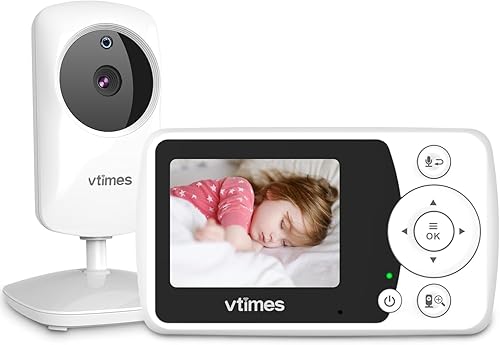
VTimes Baby Monitor with Camera and Audio: Best for travel-friendly video
- 2.4 in LCD screen
- Two-way talk
- Night vision
- Up to 1,000 ft range
The VTimes VT31 keeps the feature set compact with a portable screen, night vision, temperature sensor, ECO mode and a 1,000 ft open-area range. It suits travel and smaller spaces.
Pros
- Portable design
- ECO mode
- Includes mounting kit
Cons
- No remote pan and tilt
- Smaller screen
The VTimes Baby Monitor with Camera and Audio is a compact video option for travel and smaller rooms. Its 2.4 in LCD, portable parent unit and lithium-ion battery keep the system easy to carry.
The VT31 uses encrypted 2.4GHz FHSS and includes night vision, two-way talk, a temperature sensor and ECO mode. In ECO mode, the screen sleeps and wakes when sound is detected.
That sleep mode is useful overnight. It reduces bright screen light while still letting the monitor wake when your baby makes a sound.
Its stated range reaches up to 1,000 ft in open areas, but walls and furniture can change the usable distance. The camera can be placed freestanding or wall mounted, and a mounting kit is included.
This model does not have remote pan and tilt. Choose it if portability and a smaller display matter more than moving the camera from the parent unit.
Motorola Nursery Audio Baby Monitor: Best for long-range travel audio
- DECT 6.0 audio
- Up to 1,500 ft range
- Two-way talk
- Water-resistant travel case
The Motorola PIP12 is an audio-only travel monitor with two-way talk, rechargeable use and a stated range of up to 1,500 ft. Its travel pouch makes it practical for overnight stays.
Pros
- Longest stated range here
- Travel pouch included
- Two-way talk
Cons
- Audio only
- Shorter battery life than some video picks
The Motorola Nursery Audio Baby Monitor is the best travel audio pick for families that want a longer stated range. The PIP12 reaches up to 1,500 ft and uses DECT 6.0 for a private direct connection.
The audio-only system includes two-way talk and a water-resistant travel case. Its rechargeable battery supports up to 10 hours, while 4 AAA batteries are included.
The travel pouch makes it easier to pack for an overnight stay or vacation. It also helps keep the units together in a bag, which is useful when you are packing bottles, clothes and chargers.
Since there is no video, you do not need to find a camera angle or watch a screen during the night. You can focus on sound alerts while moving between the bedroom, kitchen or living area.
Choose the PIP12 if travel range and the case matter most. Choose the Motorola AM21v2 if you prefer a lighter basic monitor with cry detection and a 1,000 ft stated range.
Should you choose audio or video?
Choose an audio monitor if you mainly need to hear crying, stirring or other nursery sounds. The VTech DM111, Motorola AM21v2 and Motorola PIP12 are the simplest picks because they avoid camera placement and screen watching.
Audio also tends to suit busy parents who move around the home. You can clip or carry the parent unit while you cook, clean or check another room.
The trade-off is that audio cannot show you what is happening. You will hear movement or fussing, but you cannot check sleep position or see whether a blanket has shifted.
Choose video if you want to check sleep position, room activity or nighttime movement without entering the nursery. Video models here add features such as infrared night vision, sound-activated screens and two-way talk.
Night vision is the feature many parents use most. It lets you see in low light while trying not to wake a baby by opening the door.
Two-way talk can help in the moment. You may soothe your baby with your voice before deciding whether to go in.
Video also adds setup decisions. Place the camera where the view is clear, keep power cords away from the crib and check the parent unit from the areas where you will spend time.
That placement work matters more than it sounds. A camera that is too high, too low or blocked by furniture may give you a poor view.
Screen size is another practical choice. A larger display is easier to read from a bed or chair, while a smaller screen is easier to carry.
Sound activation can reduce screen watching. Some models keep the display dark until sound crosses a level you set.
For audio monitors, visual indicators can do similar work. They let you glance at nursery sound levels without turning the speaker up.
Think about your night routine before you choose. If you sleep lightly and want sound only, audio may be enough for your needs.
If you want reassurance from seeing your baby, video will likely feel worth the extra setup. The right choice depends on how you like to check in.
Neither type works well if you ignore power and range. Charge the parent unit, keep the camera plugged in and test the connection in advance.
How does a non-Wi-Fi baby monitor connect?
A non-Wi-Fi baby monitor sends audio or video directly between its baby unit and parent unit. DECT models focus on digital audio, while FHSS models in this roundup carry video or audio over a private 2.4GHz connection.
That direct link is the core idea. The camera does not need your router, and the parent unit does not need an app to receive the feed.
This setup avoids router configuration, cloud accounts and phone apps. It also means you usually cannot check the nursery from outside the home unless the system specifically supports another connection type.
For many families, that limit is acceptable. Monitoring usually happens across a home, not from another city.
DECT is common for audio monitors because it is designed for clear voice and low interference. The connection stays between the two included units.
FHSS is common for video monitors because it can carry a steadier video signal. The camera and parent unit still talk directly, without sending the feed through the internet.
Encrypted FHSS adds another layer. The signal is designed to stay private between the paired units rather than joining your home network.
Range is where daily reality can differ from the box claim. A stated 1,000 ft range is usually tested in open space.
Inside a home, walls, floors, metal objects and furniture can reduce the distance. A parent unit that works in the garden may not work reliably from a far bedroom.
That is why testing matters before bedtime. Carry the parent unit to the kitchen, bedroom, office, porch or yard and listen for dropouts.
Place the baby unit higher when possible. A clear position away from thick walls and metal shelving can help the signal travel more freely.
Keep the parent unit charged or within reach of power. A strong connection does not help if the battery runs out overnight.
Out-of-range alerts can warn you when the link breaks. Use that feature as a prompt to move closer, not as a reason to ignore the warning.
If your home has several floors, test from each level. Stairs and floor construction can affect the signal more than distance alone.
For travel, test in the actual room you will use. Hotel walls, furniture and neighboring rooms can change how the monitor performs.
Simple setup is a major benefit of direct-connect systems. Plug in, power on and confirm the units are linked before the baby is asleep.
What should you check before buying?
Start with the type of monitoring you need. Audio is enough for sound alerts, while video is better if you want night vision or a visual check.
Next, compare battery life and camera power. Parent screens may run for 8 to 30 hours, but most camera units need to stay connected to an outlet.
Range numbers are usually measured in open areas. A 1,000 ft claim does not guarantee 1,000 ft through several walls, so place the camera and parent unit where the signal is strongest.
Check expansion details before buying a second camera. The HelloBaby HB6550 can support up to 4 cameras, while the HelloBaby HB6560 supports up to 2, and model compatibility can vary.
Finally, choose controls you'll use at night. Sound activation, visual sound indicators, two-way talk and temperature alerts can reduce the need to keep watching the screen.
How should you set up and care for a direct-connect monitor?
Put the camera or baby unit on a stable surface or secure mount with a clear view of the sleep space. Keep cords away from the crib and any place your baby can reach.
Pair or power on the units before relying on them overnight. Walk with the parent unit through the rooms where you'll use it and check how walls affect the connection.
Keep the camera lens clean with a soft, dry cloth. Charge the parent unit before bedtime, and follow the specific battery and charging instructions for your model.
For audio monitors, set the volume high enough to hear normal stirring without making the unit unnecessarily loud. If your model has a sound indicator or VOX setting, adjust it after observing the nursery's usual sound level.
Which baby monitor without Wi-Fi should you buy?
Choose the VTech VM819 if you want the best balance of private video, long battery life, night vision and simple controls. Choose the Infant Optics DXR-8 PRO if interchangeable lenses and active noise reduction matter most.
Pick the HelloBaby HB6550 for broad pan and tilt with future camera expansion, or the HelloBaby HB6560 for a larger screen and split-screen viewing. For audio only, the VTech DM111 is the simplest choice, while the Motorola PIP12 suits travel with its longer stated range and case.
If you are comparing a specific brand, read our Momcozy baby monitor BM04 review before deciding between a direct-connect monitor and another camera setup.
Our top 3 picks at a glance
-
1
-
2
-
3
Best for flexible room coverage
HelloBaby No WiFi Baby Monitor Camera
9.5/10 our score
See it on Amazon
Frequently asked questions
What is the best baby monitor without Wi-Fi?
The VTech VM819 is the best baby monitor without Wi-Fi for many families because it combines encrypted 2.4GHz FHSS video, up to 19 hours of video battery life, night vision, sound activation and a 1,000 ft range.
Choose the Infant Optics DXR-8 PRO for interchangeable lenses, or the VTech DM111 if you only need audio.
Are non-Wi-Fi baby monitors safer from hacking?
A non-Wi-Fi baby monitor does not connect to your router, cloud account or the internet. Direct FHSS or DECT connections reduce internet-related exposure, but you should still place the camera securely, protect the parent unit and follow the manufacturer's setup instructions.
No connection type removes every physical or privacy risk.
Is a video baby monitor no Wi-Fi good for travel?
Yes, a video baby monitor no Wi-Fi can be useful for travel because it works without hotel internet, an app or account. Look for a portable parent screen, simple pairing, night vision and a battery that lasts through the night.
The VTimes VT31 and HelloBaby models here are video-focused choices.
What is the difference between a Wi-Fi and non-Wi-Fi baby monitor?
A Wi-Fi monitor sends video through your home network and may offer remote viewing on a phone. A non-Wi-Fi monitor sends audio or video directly to a dedicated parent unit, so it usually works without internet access or an app.
Our Wi-Fi vs non-Wi-Fi baby monitor guide explains which setup fits different households.
Does a non-Wi-Fi baby monitor work without internet?
Yes. Non-Wi-Fi monitors use a direct wireless connection between the camera or baby unit and the parent unit, so internet service is not required.
The camera still needs power, and the usable range can change with walls, furniture and other obstructions.
Check the connection before relying on it in a new room.


