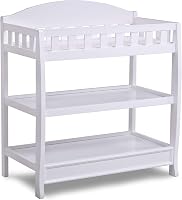
How to Choose a Corner Baby Changing Table
A corner baby changing table works best when the pad fits flat, you can reach supplies without twisting, and the unit leaves clear floor space. Measure the corner first, check pad size and safety rails, and choose open shelves you can reach from a standing position.
On this page (11 sections)
- How does a corner layout change daily access?
- What size should a corner baby changing table be?
- How do you check pad fit before you buy?
- Which corner changing table suits a small nursery?
- How does access differ in a bathroom corner?
- When is a portable or wheeled option better than a corner table?
- What safety rails and straps should you check?
- How do you arrange storage for corner shelves?
- How do you set up and care for the table?
- How do you judge finish and matching nursery pieces?
- Which corner changing table should you pick?
A corner baby changing table is a straight or purpose-built unit placed to use dead corner space while keeping the pad flat and reachable. This guide is for parents who want diaper changes out of the bedroom traffic path without giving up storage.
Start with the corner, not the product. Tape the table outline on the floor, stand where you will change the baby, and check whether you can reach wipes, diapers and cream without leaning over the pad.
Our full baby changing table guide covers the basic types, and this post focuses on corner layouts, access and pad fit.
How does a corner layout change daily access?
A corner layout helps when you stand on the open side and the walls do not block the strap, shelves or your elbow. Place the table so the long side faces the room and the short end faces the wall, not the other way around.
Many corners are not true 90 degree corners. Walls can bow, baseboards add depth, and doors often swing into the corner.
Tape a 35 inch by 20 inch outline on the floor and walk around it with a laundry basket to test the route.
Straight table turned into a corner setup
This is the most common option. You gain a defined changing zone and the wall can help keep baskets off the floor.
You lose access to the back rail and one shelf side if the table sits flush against both walls.
Keep at least 6 inches between the back of the table and the wall if you need to clean behind it. If that gap traps dust or toys, push the table flush and accept that the back is not a storage side.
Purpose-built corner changing table
A purpose-built corner unit can place the pad at an angle so you stand facing the corner. That angle can reduce twisting, but it can also make the flat pad area smaller.
Check the pad size first, then check whether the angled top still feels flat under a changing pad.
Rule: choose the layout where your standing side is open, your dominant hand can reach supplies, and no door swing crosses the pad.
What size should a corner baby changing table be?
Choose size by pad width plus rail clearance, not by the corner alone. A table that fits the corner but squeezes the pad is the wrong size.
The Delta Children Eclipse Changing Table with Changing Pad, White measures 35.25 inches wide by 36.75 inches high by 21.50 inches deep when assembled. That width gives you a sense of the footprint for a full-size straight table placed in a corner.
Depth matters as much as width. A 21.50 inch deep table needs clear space in front for your hips and feet.
If the corner is shallow, a deep table can push you into the room and block a walkway.
Measure the wall length, the baseboard depth and the door swing. Write those three numbers down before you compare products.
A table that is 2 inches too deep will feel crowded every day.
Rule: buy only if the table depth leaves standing room in front and the width leaves a flat area at least as wide as the pad.
How do you check pad fit before you buy?
Check pad fit by measuring the pad in inches and comparing it with the flat top inside the rails. The pad should sit flat, the strap should hang free, and the rails should frame the pad without pressing it.
The Delta Children Infant Changing Table with Pad, Grey lists a changing pad at 33 inches wide by 16 inches deep by 1 inch high. The assembled table is 35 inches long by 19.75 inches wide by 39.25 inches high, so the pad leaves a small margin inside the rails.
Do not assume a standard pad size. Pads vary, covers add thickness, and a liner can shift the fit.
Measure the pad you plan to use, then measure the flat area inside the rails on the table you plan to buy.
Water resistant pads and safety straps are listed for these Delta Children tables. A strap helps you secure a baby during a change, but it does not replace supervision.
Never leave a baby alone on the top.
Rule: the pad must fit flat inside the rails with no squeezing, folding or overhang, and the strap must reach without stretching.
Which corner changing table suits a small nursery?
A small nursery needs a table that earns its footprint with open shelves and a pad that fits without extra clearance. Open shelves beat drawers when space is tight because you can see supplies at a glance.
The Delta Children Infant Changing Table with Pad, White has two fixed shelves for open storage and safety rails that enclose all four sides around the top. That design suits a small room because the shelves hold diapers, wipes and cream without extra baskets on the floor.
Fixed shelves mean you cannot rearrange the height later. Measure the height of your largest supply bin before you buy.
If your bins are taller than the shelf opening, you will store them on the floor and lose the benefit.
Compare this style with our best baby changing table for small spaces if your room is under about 100 square feet. Small rooms punish deep tables and tall bins.
Rule: choose two open shelves you can reach while standing, and skip extra depth you do not need.
How does access differ in a bathroom corner?
A bathroom corner needs water resistance, easy wipe cleaning and a footprint that does not block the toilet or sink. Heat and humidity also make finishes and hardware matter more than in a bedroom.
Our best baby changing table for bathroom roundup covers bathroom-specific picks. For a corner in a bathroom, check that the table does not sit under a shower spray zone and that the pad can be wiped clean after each use.
The Eclipse table is described as wipe clean with a damp cloth. That matters in a bathroom, where splashes are common.
Keep cleaners off the wood finish unless the maker instructions say otherwise, and dry the top after use.
Corner access from the sink side
If the table sits beside a sink, you can wash hands without walking across the room. That helps at night.
It also means the table edge may get wet often, so check the finish and keep the pad cover washable.
Rule: in a bathroom, choose wipe-clean surfaces and a spot outside direct spray, with handwashing reachable without carrying the baby.
When is a portable or wheeled option better than a corner table?
A portable or wheeled option is better when the corner is not yours, the layout changes often, or you need to move the station between rooms. A fixed corner table wins when the nursery layout will stay put for months.
Our best baby changing table on wheels guide suits parents who move the station to the bedroom at night and the living room by day. Wheels help with repositioning, but they also require a flat floor and a lock or stable base during use.
Our best portable changing table guide suits travel, grandparents homes and small apartments. A portable pad on a dresser can work, but only if the dresser top is flat, the pad fits, and you store supplies within arm reach.
A best portable changing pad limits the setup to a pad and a small caddy. That is lighter and cheaper, but it gives you no shelves and no rails.
Use it on a stable surface, not on a bed or couch cushion.
Rule: choose a fixed corner table for a stable nursery, and choose wheels or a portable pad when the room layout changes weekly.
What safety rails and straps should you check?
Check for rails on all four sides, a strap on the pad, and a non toxic finish tested to safety standards. Those three items cover the main safety features you can verify before you buy.
Delta Children describes these tables as JPMA certified where listed, with a non toxic finish tested for lead and other toxic elements to meet or exceed government and ASTM safety standards. That wording is specific to the maker, so rely on it for these products and check other makers separately.
Rails should enclose the top so a baby cannot roll off the back or side. The strap should be attached to the pad and long enough to use without forcing the baby into an odd position.
Use the strap every time.
A wall-mounted option is a different category. Our best baby changing table wall mounted guide covers fold-down units for public restrooms and tight homes.
Those units save floor space but need wall studs and a different safety check.
Rule: no rails on all sides or no strap means no purchase, even if the corner fit is perfect.
How do you arrange storage for corner shelves?
Arrange storage by reach zone, not by category alone. Put the items you use every change on the top shelf, and put backups on the lower shelf.
Two shelves are typical on these tables. The top shelf should hold diapers, wipes and cream in that order from your dominant hand side.
The lower shelf can hold extra wipes, a change of clothes and a small bin for receipts or soiled items in a sealed bag.
Label the front edge of each shelf with tape if you share the room with another caregiver. Labels help guests find supplies without opening every bin.
They also help you restock before you run out.
Do not store heavy items on the top shelf. A heavy bin at waist height is easier and safer to lift than one at shoulder height.
Keep the top shelf light and close.
Rule: daily supplies go on the shelf you can reach without bending over the pad, and backups go below.
How do you set up and care for the table?
Set up the table on a flat floor, level it, and tighten every bolt before the first change. Assembly is required for these Delta Children tables, and the grey model notes that tools for assembly are included.
Read the instructions for the right order. Many tables need the frame tightened in stages so the shelves sit level.
If a shelf wobbles, loosen the bolts slightly, square the frame, then tighten again.
Care is simple. Wipe clean with a damp cloth, as listed for the Eclipse table.
Do not spray cleaners directly onto furniture, as listed for the white infant table. Dry the pad after each change and wash the cover as directed by its maker.
Check bolts and straps monthly. Wood can shift with humidity, and a strap can fray.
Tighten bolts with the tool that came with the table, not with a larger tool that can strip the holes.
Rule: level the table, tighten bolts in stages, wipe with a damp cloth, and recheck bolts and straps every month.
How do you judge finish and matching nursery pieces?
Judge finish by clean lines, a non toxic finish, and whether it matches pieces you already own. A changing table does not need to match every piece, but a close match helps a small room feel calm.
Delta Children notes that the grey Wilmington style can pair with other Delta Children pieces in matching colors. That matters if you already own a crib or dresser from the same line.
If you do not, choose a finish that matches your floor or wall color instead.
White finishes show scuffs and cream marks more than grey. Grey can hide shadows but show dust.
Either finish wipes clean with a damp cloth when you follow the care notes above.
If you are still choosing the sleep setup, our How to Choose a Bassinet: A Quick Overview guide helps you plan the whole corner. A bassinet beside the changing table can cut nighttime trips across the room.
Rule: match the finish to pieces you own or to the floor, and choose the color you will wipe clean most often.
Which corner changing table should you pick?
Pick the Eclipse table if you need a known footprint of 35.25 by 21.50 inches with two shelves and rails. Pick the white infant table if you want a straightforward design with two fixed shelves.
Pick the grey table if you want a listed pad size of 33 by 16 inches to check fit before you buy.
All three options here are straight tables, not angled corner units. That is normal for this category.
A straight table placed in a corner works when the pad fits flat and your standing side stays open.
Revisit the corner measurements, pad fit and reach test from the start of this guide before you order. Those three checks decide more than color or finish.
A corner baby changing table that passes those checks will serve you daily without crowding the room.
Frequently asked questions
What is a corner baby changing table?
A corner baby changing table is nursery furniture designed to sit in a corner or be placed so two walls help frame it. Most practical options are still straight tables turned into a corner setup, so pad fit, side access and door swing matter more than the corner label.
Is a corner changing table safe for a baby?
A corner changing table can be safe when it has safety rails on all sides, a strap on the pad, and a stable base on a flat floor. Never leave a baby alone on the top, even in a corner, and use the strap every time.
Check the maker instructions for weight and placement limits.
What size pad fits a corner changing table?
Measure the flat top and the included pad before you buy a cover or liner. The pad should sit flat with rails around it and should not be squeezed to fit.
If the pad is 33 inches wide, the top needs at least that much clear flat space.
Can you use a straight changing table in a corner?
Yes, many people place a straight changing table so one short end sits near a wall. That works when you keep rails clear, leave room to stand at the long side, and do not block shelves with the wall.
Measure both wall lengths before you move furniture.