Baby Changing Tables: The Complete Buying Guide
A baby changing table is a raised, enclosed changing station with storage for diapers, wipes and creams close at hand. Choose the type that fits your nursery wall, your storage needs and the pad size you will buy next.
On this page (9 sections)
- What types of baby changing table are there?
- Which baby changing table suits your nursery layout?
- How much storage does a baby changing table need?
- What safety features should you look for on a changing station?
- Which products show the main design choices?
- How do you choose between wood, dresser and open shelf designs?
- What should you stock at a baby changing table station?
- How do you clean and care for a changing table?
- How do you decide which baby changing table to buy?
A baby changing table is a nursery station built for diaper changes, with a raised top, rails or a recessed area and storage for supplies. You do not need a separate table if you already have a dresser, but a dedicated station keeps wipes and creams in one place.
This guide covers the main types, where to place a changing station, how much storage you really need and the buying decisions that matter most. Related terms include baby changing table nursery, baby changing table for nursery, baby changing table station and table baby changing station.
You will also see four real examples that show how different designs handle the same daily task. We compared the specs, materials, dimensions and included items for each one so you can judge fit before you order.
Our score weighs specs, features and buyer feedback against what you are shopping for. Scores are shown in the product boxes as a quick guide, and the detailed notes below explain what each score is based on.
What types of baby changing table are there?
There are four common types: dedicated changing tables, dresser changers, changing table toppers and portable or wall mounted stations. Each one trades storage, footprint and later use in a different way.
A dedicated changing table is built only for changing. It usually has an enclosed top with rails on four sides and open shelves below.
You get a clear changing area and a simple footprint, but you do not get drawers for clothes.
A dresser changer combines a dresser with a changing top. Drawers hold clothes, diapers and creams, and the top holds the pad.
This type is popular in a baby changing table for nursery because it can stay in the room after the changing stage ends.
A changing table topper sits on top of a dresser you already own. It adds rails and a recessed pad area without adding drawers.
Our guide to the best changing table topper explains when a topper is enough and when a full dresser changer is the better buy.
A portable changing pad is not a table at all. It is a thin pad you place on a flat surface or carry in a bag.
For travel, a best portable changing pad with a wipe clean surface often beats a full station you cannot pack.
Wall mounted stations fold down from a wall and are common in public restrooms. They save floor space but offer no storage.
A list of best baby changing table wall mounted options is useful for commercial spaces, but most homes do better with a table or dresser changer.
| Type | Storage | Footprint | Later use |
|---|---|---|---|
| Dedicated table | Open shelves | Narrow to wide | Storage shelf or side table |
| Dresser changer | Drawers plus shelves | Wide | Dresser for clothes |
| Topper | None added | Dresser width | Remove and store |
| Portable pad | None | Folds or rolls | Travel and home use |
Which baby changing table suits your nursery layout?
The right baby changing table for nursery use matches the wall you have, not the room you wish you had. Measure the wall, the door swing and the space where you will stand before you pick a width.
A wide dresser changer, around 43 in wide, needs a long clear wall. It will not fit neatly between a crib and a window if that gap is only 36 in.
A narrower dedicated table, around 35 in wide, fits more walls and still leaves room for a diaper caddy nearby.
Think about where you will stand. You should face the table squarely, with your feet about hip width apart and your hips level.
If you have to twist to reach wipes, you will feel that twist many times a day.
Keep the station away from windows, cords, lamps and wall art that sits low. Babies grab, pull and push as they grow.
A changing station should be a plain zone with nothing within reach above or beside the changing top.
For small rooms, our best baby changing table for small spaces guide explains how to choose a narrow model, skip bulky drawers and use vertical storage instead. A small station with two open shelves can work well if you keep supplies sorted in bins.
Placement beside the crib is common, but it is not required. Some parents prefer the station near the bathroom door to shorten trips for water and towels.
Others place it near a dresser so clothes and changing supplies stay in one zone.
Mark the table outline on the floor with tape, stand in front of it and reach for each shelf. If you need to lean, step sideways or reach above your shoulder, move the station or choose a lower model.
How much storage does a baby changing table need?
Storage needs depend on how many diapers, wipes, creams and spare clothes you keep at the station. Open shelves show what you have, while drawers hide it and keep it dust free.
Two open shelves can hold a stack of diapers, a box of wipes, a small bin for creams and a few spare onesies. That is enough for many families if a dresser or closet is nearby for bulk stock.
Six drawers give you a different kind of storage. You can separate newborn clothes, larger sizes, towels and creams by drawer.
That helps if this piece will also serve as a dresser for the room.
Check drawer size, not just drawer count. A deep drawer that is 12 in wide by 16.9 in deep by 9 in high will hold folded clothes and a diaper stack in a way a shallow drawer will not.
Measure your folded clothes before you assume a drawer will fit them.
Open shelves are faster to use. You can see at a glance which size diaper is running low.
Drawers are tidier and keep items out of sight, which helps in a small nursery where visual clutter can feel busy.
Wheels and adjustable shelves add flexibility. A model with four removable wheels with safety locks can move from room to room, while an adjustable shelf can fit a tall diaper pail or a small wipe box.
If drawers are your priority, start with our best changing tables with drawers list. It compares deep drawers, fabric drawers and open shelves so you can pick the storage style that matches how you organize supplies.
What safety features should you look for on a changing station?
Safety on a baby changing table station starts with rails on all four sides and a pad that fits the top exactly. Those two features keep your baby from rolling off while you use both hands.
Look for safety rails or baffles that enclose the top. A fully enclosed area does not replace supervision, but it gives you a margin of safety during a change.
A safety strap on the pad adds another layer, and you should use it as directed.
Check the pad size against the table size. The Scout Changing Table accepts a pad that is 32 in wide by 16 in deep by 1 in high.
A pad that is smaller leaves gaps at the edges, and a pad that is larger will not sit flat.
Non toxic finishes and testing to government and ASTM standards matter for nursery furniture. Delta Children says its Scout table uses a non toxic multi step painting process that is lead and phthalate safe.
The Delta Children Infant Changing Table says its finish is non toxic and tested for lead and other toxic elements to meet or exceed government and ASTM safety standards.
Do not spray cleaners directly onto furniture. Wipe surfaces with a damp cloth and dry them right away where the maker directs that care.
That protects the finish and keeps the surface easy to clean after diaper changes.
Never leave a baby alone on a changing table, even for a few seconds. Keep wipes, creams and spare diapers within reach before you lift your baby onto the top.
If you plan to buy a separate pad, compare our best baby changing pads list for contour, waterproof and strap options. Also check best changing pad covers so you have a clean cover ready when one is in the wash.
How do you set up a safe changing area?
Set up the station before your baby arrives, with supplies sorted and the pad secured. Place the pad in the recessed area, fasten the strap and test that it does not shift when you press it.
Stock the top shelf with diapers in the current size, wipes and a small amount of cream. Keep a spare onesie and a towel within reach but out of your baby's grab zone.
Test the height. Your elbows should be bent slightly when your hands rest on the pad.
If the table is too low, you will bend at the waist. If it is too high, you will lift your shoulders.
Secure the table to the wall if the maker directs it. A tall dresser changer can tip if a toddler climbs it later.
Wall anchoring and keeping heavy items in lower drawers reduce that risk.
Show every caregiver where supplies live and how the strap works. A station that only one person knows how to use will not help during night changes.
Which products show the main design choices?
Four products below show the main trade offs in a baby changing table nursery. A dedicated table, a wide dresser changer, a narrow open shelf table and a mobile dresser each solve a different problem.
Read the dimensions and included items with care. Two models can look similar in photos and differ in pad inclusion, shelf count and width.
Those differences decide whether the station fits your wall and your routine.
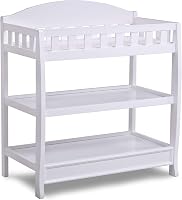
Delta Children Infant Changing Table with Pad: enclosed top and included pad
The Delta Children Infant Changing Table with Pad suits parents who want an enclosed top and a pad in the box. It has strong wood construction, safety rails on all four sides and two fixed shelves for open storage.
The included water resistant changing pad with a safety strap saves a separate purchase. You still need to confirm the pad size before you order a replacement or a cover.
Two fixed shelves hold diapers, wipes, creams and toys. Fixed shelves cannot be moved to fit a tall pail, so plan your bins around the shelf height you have.
The maker says the non toxic finish is tested for lead and other toxic elements to meet or exceed government and ASTM safety standards. Assembly is required, and the maker directs you not to spray cleaners directly onto furniture.
Choose this model for a simple, enclosed station with the pad included. Skip it if you need drawers for clothes or an adjustable shelf for tall items.
For the white finish and matching nursery pieces, see our best baby changing table white guide. It explains how to coordinate a white table with a crib and dresser without buying the whole set at once.
BOLUO Baby Dresser with Changing Table Top: drawers plus a removable top
The BOLUO Baby Dresser with Changing Table Top suits parents who need six drawers and a wide changing top in one piece. It measures 43.7 in wide by 19.7 in deep by 37.2 in high, with a changing top that is 19.7 in wide.
Six deep drawers and three open shelves hold clothes, creams, towels and socks. Drawer size is 12 in wide by 16.9 in deep by 9 in high, which helps you plan folded storage.
The changing pad is not included. You will need to buy a pad that fits the 19.7 in wide top and check that it sits securely before use.
The top is removable. You can take the top apart when you no longer need it and use the piece as a 6 drawer dresser for bedroom storage.
That later use is a real benefit if you plan to keep the piece in the nursery.
Four adjustable feet protect the floor from scratches. The maker describes the design as ergonomic, with a height meant to reduce bending, and says the piece is lightweight enough to move between rooms.
Wipe clean with a dry cloth.
Choose this model for wide walls and a need for drawer storage. Skip it if your wall is narrow or if you prefer wood drawers over fabric drawers.
For black finishes and matching pieces, see our best baby changing table black list. It compares black models by drawer type, top width and pad inclusion.
Delta Children Scout Changing Table: narrow size and open shelves
The Delta Children Scout Changing Table suits parents who need a narrower table with two open shelves and a contemporary look. It measures 35.25 in wide by 18.75 in deep by 34.7 in high.
Shelf size is 32.25 in wide by 16.50 in deep, with 11.75 in between shelves. That spacing fits diapers, wipes and small bins, but it will not fit a tall pail on the lower shelf without checking the height.
The changing pad is sold separately. The maker says to pair the table with a Serta, Beautyrest or Simmons Kids contour pad for safety and fit, and the accepted pad size is 32 in wide by 16 in deep by 1 in high.
Materials include sustainable woods like pine and TSCA compliant engineered wood. The maker says the table is Baby Safety Alliance Verified and uses a non toxic multi step painting process that is lead and phthalate safe.
The maker says the table can be used as a storage piece or bar cart later on. That makes it a flexible pick if you want a piece that moves out of the nursery.
Choose this model for narrower walls and open shelf storage. Skip it if you need drawers, wheels or an included pad.
For wood finishes and coordinating pieces, see our best baby changing table wood guide. It explains how pine, engineered wood and painted finishes differ in care and look.
YeTom Changing Table: mobile dresser with adjustable shelf
The YeTom Changing Table suits parents who need six drawers, an adjustable shelf and wheels for moving the station. It measures 43 in wide by 16.7 in deep by 40.5 in high.
The maker says the drawers store 300 plus diapers, onesies and creams. An adjustable open shelf can fit a tall diaper pail or a small wipe box, with flexible height for each stage.
The changing pad is made of waterproof PVC material that is easy to wipe clean. The maker says the piece has four removable universal wheels with safety locks, so you can move it from one room to another and lock it in place.
Safety baffles on four sides enclose the changing area, and the maker says a safety lanyard is included. The maker says the table is tested for lead and other toxic elements and meets applicable CPSC and ASTM standards.
Construction uses high quality P2 Grade PB for the changing table topper. The maker says you can assemble it in 15 to 20 minutes with detailed instructions and all hardware included.
Choose this model for mobility and adjustable storage. Skip it if you need a narrow footprint or a fixed table without wheels.
For brown finishes and dresser styles, see our best baby changing table dresser brown list. It compares drawer depth, top size and pad material across brown models.
How do you choose between wood, dresser and open shelf designs?
Your finish choice should match the crib and dresser you already own, or the finish you plan to buy next. A mismatch can make a small nursery feel fragmented, while a match can make the room feel calm.
Oak is a warm, natural choice that works with many wood tones. Our guide to how to choose a baby changing table oak explains grain, finish care and how to match oak to other nursery wood without buying a full set.
White is easy to coordinate and brightens a small room. It shows scuffs and marks more than a darker finish, so wipe it regularly and check the finish after spills.
A white model with an included pad can save time if you want a complete station at once.
Black adds contrast and hides some marks, but it can show dust. Fabric drawers in a black model need regular vacuuming, while wood drawers wipe clean with a damp cloth.
Chestnut and rustic brown finishes sit between white and black. They pair well with pine and engineered wood pieces, and they hide minor marks better than white.
Check the exact finish name, because chestnut, brown and rustic brown are not always the same color.
Our overall best changing table guide ranks models by storage, safety features and pad inclusion. Use it to shortlist two or three models, then compare dimensions and drawer sizes for your wall.
Dresser changers in the Delta Children line are compared in our best delta children changing table list. That list helps if you prefer one brand for the crib, dresser and changing station so finishes match.
What should you stock at a baby changing table station?
A good station holds only what you need for a change, within arm's reach and out of your baby's grab zone. Bulk stock can live in a closet or dresser, while the station holds the current size and a small backup.
Stock diapers in the current size on the top shelf, with the next size stored below. Keep wipes in a container you can open with one hand.
A small amount of cream or ointment is enough, and you can refill it from bulk storage.
Keep a spare onesie, a towel and a muslin cloth in a bin or drawer near the top. Babies often need a full outfit change, and reaching for clothes while holding a baby on the table is unsafe.
A small trash bin or pail near the station helps you avoid leaving the table. If you use a pail with a lid, check that the shelf or floor space fits its height before you buy it.
Our checklist of baby changing table necessities covers pads, covers, straps, bins and backup supplies. Use it to set up the station before your baby arrives, so night changes do not require a hunt through drawers.
For travel and grandparents' homes, a portable pad can fill the gap. Pair a home station with a travel pad instead of moving a dresser changer between houses.
How do you clean and care for a changing table?
Care depends on the material, and the maker directions for your model come first. Wipe wood with a damp cloth and dry it right away where directed.
Do not spray cleaners directly onto furniture.
Fabric drawers need vacuuming to remove dust, lint and crumbs. Wipe engineered wood and painted wood with a dry or damp cloth, then dry the surface.
Waterproof PVC pads wipe clean with a damp cloth and mild soap where the maker directs it.
Check rails, straps and wheels monthly. Tighten screws, test that the strap buckle works and lock wheels before each use.
If a wheel or strap is damaged, stop using that feature until you replace the part.
Check the finish for chips and scratches. Touch up small marks with the maker approved method, or cover a worn area with a pad or storage bin.
Replace a pad that is cracked, torn or no longer fits the top.
Store the manual and any spare hardware in a labeled bag. That helps if you move, sell or hand down the piece later.
A changing station that you can disassemble and reassemble correctly will last longer in your home.
Assembly matters at the start. Follow the instructions step by step, check that all hardware is included and test the table for wobble before you place a pad on it.
How do you decide which baby changing table to buy?
The best baby changing table fits your wall, holds your supplies and includes or accepts the right pad size. Start with those three checks, then compare finish and later use.
Measure your wall and mark the table outline on the floor. If the wall is under 38 in wide, a narrow table around 35 in wide is a safer starting point.
If the wall is 44 in or wider, a dresser changer around 43 in wide can fit with room to stand.
Decide on storage. Choose open shelves if you want to see supplies at a glance.
Choose drawers if you need clothes storage or a tidier look. Choose wheels and an adjustable shelf if you plan to move the station between rooms.
Check pad inclusion. An included pad saves a separate purchase, while a pad sold separately means you must match the size exactly.
The Scout table needs a 32 by 16 by 1 in pad, while the BOLUO top needs a pad that fits a 19.7 in wide top.
Match the finish to your nursery. White, black, chestnut, oak and rustic brown each pair with different crib and dresser finishes.
Order a sample or check the finish name before you buy a second piece.
Think about later use. A removable top turns a changer into a dresser.
Open shelves can become storage for toys or books. A dedicated table with fixed shelves has fewer later uses, so weigh that against its simpler footprint.
Set up the station with supplies sorted, the strap tested and the table anchored where directed. That first setup will make daily changes faster and safer for you and your baby.
Pick the Delta Children Infant Changing Table with Pad if you want an enclosed top and a pad included. Pick the BOLUO dresser changer if you need six drawers and a removable top.
Pick the Scout table if your wall is narrow and open shelves are enough. Pick the YeTom dresser if you want wheels, six drawers and an adjustable shelf.
Frequently asked questions
What is a baby changing table used for?
A baby changing table gives you a raised place to change diapers with safety rails around the top and storage below for diapers, wipes and creams. It keeps supplies within reach while you keep one hand on your baby.
Do I need a pad for a baby changing table?
Most changing tables need a separate or included pad with a strap or contour sides. Check the exact pad size for the model first, because a pad that is too small leaves gaps and a pad that is too large will not sit safely.
Where should a baby changing table go in the nursery?
Place it against a wall where you can stand squarely in front of it and reach storage without twisting. Keep it away from windows, cords and items your baby can grab, and leave room to step back safely.
Can a changing table be used after the baby stage?
Many dresser style changing stations can become a dresser or storage piece after you remove the changing top or pad. Open shelf models can hold toys, books or household items later in a different room.