8 Best Baby Monitors with Night Vision (November 2026)
The best night vision baby monitors include the Tapo 1080P Indoor Security Camera for app alerts, the HelloBaby No WiFi Baby Monitor 2 Cameras for two-room monitoring, and the VTech Baby Monitor No WiFi for simple private monitoring.
On this page (6 sections)
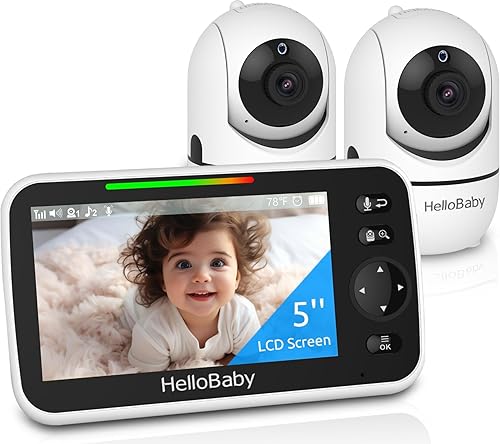
The best night vision baby monitor for most families is the HelloBaby HB6550 with 2 cameras, because its 5-inch screen, private no-WiFi connection and automatic infrared view cover two rooms.
That combination suits parents who move between a nursery and another room during the night. One parent screen shows either room, so you do not need to carry a phone for routine checks.
Choose a VTech monitor if you want a simpler single-camera setup. Its smaller screen and direct controls can be easier when there is only one sleep space to watch.
Choose Tapo if app alerts and phone viewing matter more than a dedicated screen. A smartphone view also helps when you are away from home and need a quick check.
Night vision matters most when the nursery is dark enough that a normal camera view becomes hard to read. Infrared systems let you check movement, position and visible bedding without switching on a bright light.
That matters because light can wake a light sleeper. A clear dark view gives you a middle option between going in silently and turning on the overhead light.
It also helps you check the crib after a feed or change. You can confirm your baby has settled before deciding whether to enter the room.
If you need help comparing connection types, start with our guide to the best baby monitor system. It explains how parent screens and app cameras differ in daily use.
Families who want phone access can also compare these picks with our best baby monitor with camera guide. That comparison focuses on viewing from a phone or tablet rather than a handheld screen.
The right pick depends on your home layout and sleep routine. Think about where you will watch most often, how often you travel, and whether one room or two rooms need coverage.
A dedicated screen is often easier during night feeds. It stays on the nightstand, works without opening an app, and does not depend on your home network.
An app camera is often more flexible during the day. It can send alerts to your phone while you are in another part of the house or at work.
Neither choice is right for every family. The wider reviews in this roundup show how screen size, camera movement and connection type change the trade offs.
Use the picks below as a shortlist, then check each camera count and power requirement before you buy. That keeps the choice tied to an actual room and routine.
The HelloBaby HB6550 leads this list for two-room households. Its private link and larger screen make it the default choice unless phone access is your main need.
Our picks at a glance
-
1

-
2
 Best for two-room monitoring
HelloBaby No WiFi Baby Monitor 2 Cameras
9.6/10 our score
See it on Amazon -
3

- 4
 Check it
HelloBaby No WiFi Baby Monitor 2 Cameras
Best for split-screen viewing - 5
 Check it
HelloBaby 4.3'' Video Baby Monitor No WiFi
Best for long battery life - 6
 Check it
VTimes Baby Monitor with Camera and Audio
Best for portable no-WiFi use - 7
 Check it
VTech Video Baby Monitor No WiFi
Best for remote camera control - 8
 Check it
Tapo 1080p Pan/Tilt Security Camera for Baby
Best for whole-room app viewing
The best night vision baby monitor picks
The HelloBaby HB6550 is the strongest overall choice for two-room monitoring, while the Tapo C100 is the best app camera. The remaining picks focus on private no-WiFi viewing, split-screen coverage, battery life or remote camera control.
Our score weighs specs, features and buyer feedback against what you're shopping for. We compared the stated screen, connection, camera movement, battery and infrared features, but we did not test these monitors in person.
| Product | Best for | Video | Connection | Night vision | Our score |
|---|---|---|---|---|---|
| Tapo 1080P Indoor Security Camera | app alerts | 1080P HD | Wi-Fi | Up to 30 ft | 9.7 |
| HelloBaby No WiFi Baby Monitor 2 Cameras | two-room monitoring | 2.4GHz FHSS, no Wi-Fi | 9.6 | ||
| VTech Baby Monitor No WiFi | simple private monitoring | 2.4GHz FHSS, no Wi-Fi | 9.4 | ||
| HelloBaby No WiFi Baby Monitor 2 Cameras | split-screen viewing | 2.4GHz FHSS, no Wi-Fi | 9.3 | ||
| HelloBaby 4.3'' Video Baby Monitor No WiFi | long battery life | 2.4GHz FHSS, no Wi-Fi | 9.1 | ||
| VTimes Baby Monitor with Camera and Audio | portable no-WiFi use | 2.4GHz FHSS, no Wi-Fi | 9.1 | ||
| VTech Video Baby Monitor No WiFi | remote camera control | 2.4GHz FHSS, no Wi-Fi | 9.1 | ||
| Tapo 1080p Pan/Tilt Security Camera for Baby | whole-room app viewing | 1080P Full HD | 2.4GHz Wi-Fi | Up to 30 ft | 8.2 |
Tapo 1080P Indoor Security Camera: Best for app alerts
- 1080P video
- Night vision up to 30 ft
- Baby crying detection
- 2-way audio
The Tapo C100 suits parents who want to check a nursery from a smartphone or tablet. Its 1080P video, baby crying detection and 30-ft infrared night vision give it the broadest app-based feature set here.
Pros
- 1080P video
- Baby crying detection
- Works with Alexa and Google Assistant
Cons
- Requires Wi-Fi
- Wired camera
The Tapo 1080P Indoor Security Camera is the best night vision baby monitor here for parents who want to check the nursery from a phone, tablet or compatible voice assistant. Its 1080P video gives you more image detail than the smaller dedicated monitor screens.
The camera's infrared system provides night vision up to 30 ft, which suits many bedrooms when the camera is positioned near the crib. Baby crying detection and motion or person notifications can alert you while the app is open or running in the background.
Two-way audio lets you speak through the camera. The C100 is wired, so place it near a suitable outlet and keep the cable away from the crib and other reachable areas.
The Tapo C100 works best when your home Wi-Fi is reliable and you want phone access. It is less suitable if you prefer a dedicated parent screen or want monitoring that continues when the home network is unavailable.
HelloBaby No WiFi Baby Monitor 2 Cameras: Best for two-room monitoring
- Two cameras
- 5-inch IPS screen
- Up to 30 hours in ECO mode
- 1000-ft outdoor range
The HelloBaby HB6550 is a strong choice for two rooms because its 5-inch parent screen switches between two cameras and its private FHSS link does not use Wi-Fi.
Pros
- Two cameras included
- Long ECO battery life
- Remote pan, tilt and zoom
Cons
- Single view, not split-screen
- Outdoor range does not equal indoor range
The HelloBaby HB6550 is the best night vision baby monitor for two rooms without Wi-Fi. It includes two cameras and a 5-inch IPS parent screen that switches between views, but it does not show both rooms at the same time.
Automatic infrared night vision helps you see both camera feeds after the nursery lights go out. Remote pan, tilt and zoom let you adjust the view from the parent unit, which is useful when one camera needs to cover more than the crib.
The private 2.4GHz FHSS connection does not need an app or home network. The parent screen can run for up to 30 hours in ECO mode, and the sound-activated screen can wake when noise passes your selected threshold.
This is a strong fit for twins, a nursery and playroom, or two separate sleep spaces. Choose the HB6560-2 below if seeing both rooms at once matters more than a one-at-a-time view.
VTech Baby Monitor No WiFi: Best for simple private monitoring
- 2.8-inch LCD
- Up to 19 hours of video
- 1000-ft range
- 2x digital zoom
The VTech VM819 keeps setup simple with a camera, parent unit and direct FHSS connection. Automatic infrared night vision and 2x zoom help you check a dark crib without entering the room.
Pros
- No app or cloud account
- Sound-activated screen
- Temperature sensor
Cons
- One camera
- Smaller screen
The VTech VM819 is the best night vision baby monitor for simple private monitoring in one nursery. Its 2.8-inch LCD is smaller than the screens on most other picks, but the automatic infrared night vision activates when the room gets dark.
The camera and parent unit use encrypted 2.4GHz FHSS transmission, so no Wi-Fi, internet connection or cloud account is needed. That direct connection also avoids app setup and keeps the monitor focused on the parent unit.
A 2x digital zoom helps you inspect the crib from the parent unit. Sound-activated screen mode keeps the display dark when the room is quiet, then turns it on when the monitor detects sound.
The 2600mAh battery supports up to 19 hours of continuous video or up to 29 hours of audio-only monitoring. Choose it when a compact screen and straightforward controls matter more than multiple cameras or remote pan and tilt.
HelloBaby No WiFi Baby Monitor 2 Cameras: Best for split-screen viewing
- 6-inch split screen
- Two cameras
- Up to 30 hours in VOX or ECO mode
- Night vision
The HelloBaby HB6560-2 is made for watching two rooms at once. Its 6-inch split screen shows both cameras together, while infrared night vision keeps both views available in darkness.
Pros
- True split-screen view
- Two cameras included
- Remote pan and tilt
Cons
- No Wi-Fi or app access
- The stated 1000-ft range is outdoors
The HelloBaby HB6560-2 is the best night vision baby monitor for split-screen viewing. Its 6-inch IPS display shows two camera feeds side by side, so you can watch a crib and play area without switching between cameras.
Automatic infrared night vision keeps both views available in a dark room. The two cameras also offer remote pan and tilt, while VOX and ECO modes can reduce screen use when the nursery is quiet.
This model uses a private 2.4GHz FHSS link and does not require Wi-Fi or an app. Its stated outdoor range reaches up to 1000 ft, but walls and furniture can reduce usable indoor distance.
The HB6560-2 suits twins or parents who need two rooms visible at once. Its split screen uses more display space for each feed than a single-camera view, so compare whether simultaneous coverage or a larger single image is more useful.
HelloBaby 4.3'' Video Baby Monitor No WiFi: Best for long battery life
- 4.3-inch IPS screen
- Up to 30 hours in ECO mode
- 3500mAh battery
- Remote pan, tilt and zoom
The HelloBaby HB6148 fits parents who want a larger screen and long battery life without an app. Its automatic infrared night vision and remote camera movement suit a single nursery.
Pros
- Up to 30 hours in ECO mode
- 350-degree pan
- 120-degree tilt
Cons
- One camera included
- Camera must stay plugged in
The HelloBaby HB6148 is the best night vision baby monitor for long battery life on a single-camera setup.
Its 4.3-inch IPS screen is large enough for routine crib checks. IPS viewing also keeps the picture clearer when you look at it from an angle on a nightstand or couch.
ECO mode can extend the battery to up to 30 hours. That suits overnight use when you do not want to plug the parent unit in beside the bed.
Automatic infrared night vision shows the nursery in low light without a visible lamp. You can check blankets, position and movement while the room stays dark.
The camera supports remote pan, tilt and zoom. That helps when a baby moves toward one side of the crib and the fixed view would miss the action.
It offers 350-degree rotation and 120-degree vertical movement. Those angles cover corners and high monitor positions better than a small fixed camera on a shelf.
The monitor uses 2.4GHz FHSS technology and does not need Wi-Fi or an app. Setup stays simple because the camera and parent unit connect directly.
Sound-activated screen mode can turn the display off when the room is quiet. It then wakes when sound is detected, which saves power and reduces light in a shared bedroom.
The camera must stay plugged in, so plan the power cable before mounting it. Keep the cable out of reach and away from the crib as part of safe placement.
Choose this model if you want a larger screen and long parent-unit battery life without adding a second camera. It fits a single nursery where quiet overnight monitoring matters most.
VTimes Baby Monitor with Camera and Audio: Best for portable no-WiFi use
- 2.4-inch LCD screen
- Automatic night vision
- 1000-ft open-area range
- Temperature sensor
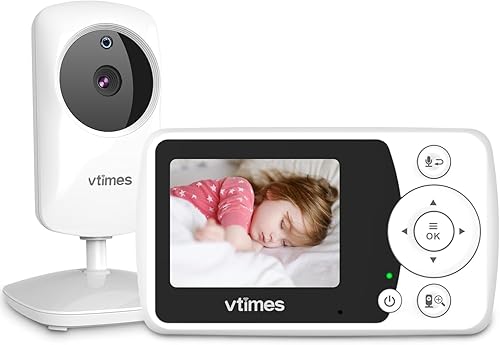
The VTimes VT31 is a compact no-WiFi monitor for parents who want a portable parent unit. Automatic night vision works in low light, while the ECO mode turns the screen on when sound is detected.
Pros
- Portable parent screen
- No app required
- Wall-mounting option
Cons
- No remote pan and tilt
- Smaller screen
The VTimes VT31 is the best night vision baby monitor for portable no-WiFi use.
Its 2.4-inch LCD parent unit is compact and easy to carry between rooms. That small size suits a nightstand, a kitchen counter, or a weekend stay with grandparents.
The monitor connects through encrypted 2.4GHz FHSS rather than a phone app or home network. You can watch without signing in, downloading an app, or relying on Wi-Fi.
Automatic night vision supports dark-room checks. It gives you a view of the crib when the nursery lights are off, without needing a lamp beside the camera.
ECO mode lets the screen sleep until sound from the nursery wakes it. That can save battery during long naps and quiet stretches overnight.
The monitor also includes a temperature sensor, alarm and lullaby functions. Those extras help you respond to crying or check room comfort without opening the nursery door.
The VT31 supports freestanding placement and wall mounting. A shelf works for a quick setup, while a wall position can give a steadier view of the crib.
Its camera does not have remote pan and tilt, so adjust the camera angle by hand during setup. Check the frame at night before you fix the position.
The stated range is up to 1000 ft in open areas, though walls and furniture can reduce that distance. Treat the figure as an outdoor limit rather than a promise through a whole house.
Choose the VTimes if you want a compact parent unit and simple travel-friendly monitoring. It suits families who value portability over a larger screen or moving camera.
VTech Video Baby Monitor No WiFi: Best for remote camera control
- 5-inch screen
- Remote pan, tilt and 2x zoom
- Up to 17 hours of video
- Automatic infrared night vision
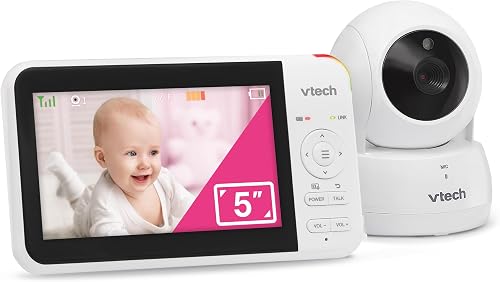
The VTech VM924 gives you remote control over the camera from a 5-inch parent unit. Its infrared night vision, temperature sensor and private FHSS connection suit a single nursery.
Pros
- Remote pan, tilt and zoom
- 5-inch screen
- Wall-mount bracket included
Cons
- One camera
- Shorter video battery life than some picks
The VTech VM924 is the best night vision baby monitor for remote camera control from a dedicated parent screen. Its 5-inch display gives you more viewing area than the VM819, while the camera provides remote pan, tilt and 2x zoom.
Automatic infrared night vision activates when the nursery becomes dark. The built-in temperature sensor displays the room reading on the parent unit, and two-way talk lets you speak through the camera.
The VM924 uses encrypted 2.4GHz FHSS transmission without Wi-Fi, an app or cloud storage. Its parent unit supports up to 17 hours of continuous video or up to 31 hours of audio-only monitoring.
The camera and parent unit are designed for one nursery. Choose this model if you want to reposition the view from your chair without entering the room, and compare it with our best long range baby monitor guide if distance is your main concern.
Tapo 1080p Pan/Tilt Security Camera for Baby: Best for whole-room app viewing
- 1080P video
- 360-degree horizontal view
- 114-degree vertical view
- Night vision up to 30 ft
The Tapo C201 is a good fit when whole-room movement and phone access matter more than a dedicated parent screen. Its pan and tilt coverage can follow a larger nursery from an app.
Pros
- 360-degree horizontal view
- Baby crying detection
- Local or cloud storage options
Cons
- Requires Wi-Fi
- Wired electric power
The Tapo C201 is the best night vision baby monitor for whole-room app viewing.
Its 1080P video gives more detail than the smaller dedicated monitor screens in this roundup. That extra detail helps you read bedding, movement and objects held near the crib.
The camera offers 360-degree horizontal movement and 114-degree vertical movement. That range helps cover more of a nursery than a fixed camera placed on a dresser.
You can point it toward the crib, then pan toward the door or play area. That flexibility suits a larger room where a baby moves beyond one fixed frame.
Infrared night vision reaches up to 30 ft, and baby crying detection can send an alert through the app. The alert is useful when you are not watching the live view.
Two-way audio lets you speak through the camera, while motion and person detection provide additional notifications. Those alerts can help you decide whether a sound needs a trip to the nursery.
The C201 connects through 2.4GHz Wi-Fi and works with smartphones and tablets. A stable home network matters because the live view and alerts travel through that connection.
It is corded electric, so choose a location with safe cable routing and enough room for the camera to move. Keep the cable away from the crib and other reachable areas.
Local recording can use a microSD card up to 512 GB, which is not included. Cloud storage is another option through Tapo Care for longer access to clips.
Choose this model if phone access and room coverage matter more than a dedicated handheld monitor. It fits parents who already rely on a phone for nighttime checks.
How to choose a video baby monitor with night vision
The best video baby monitor with night vision depends first on how you want to view the nursery.
Dedicated monitors such as HelloBaby, VTech and VTimes include a parent screen. Tapo cameras instead send video to a smartphone or tablet over Wi-Fi.
That difference shapes your whole night routine. A parent screen sits ready on a nightstand, while an app camera asks you to open a phone and open the app.
A no-WiFi monitor can be easier to use at night because the parent unit is ready without an app. It also avoids relying on the home network for the picture.
For many parents, that simplicity matters during feeds and soothing. You can glance at the screen, press talk, or check the temperature without touching a phone.
A Wi-Fi camera can be more flexible if you want alerts while away from the house. It can also suit parents who already use a phone as their main screen.
Phone viewing helps when one parent works late or travels. The other parent can still check the nursery from another room or from outside the home.
Screen size is the next thing to compare. A larger IPS or LCD screen is easier to read when you are tired, while a small screen is easier to carry.
Camera movement also changes the choice. Remote pan and tilt help in a wide nursery, while a fixed camera is simpler if the crib stays in one place.
Battery life matters if the parent unit will move around the house. ECO and sound-activated modes extend use, but they may keep the screen dark until sound is detected.
Night vision range and position matter more than the label alone. A camera placed across a large room may give a weaker view than one placed closer to the crib.
Think about power before you mount any camera. A plugged-in camera needs a safe outlet and a cable route that stays out of reach.
Choose based on the view you will use most often. If that view is a handheld screen at home, a no-WiFi model may fit better than an app camera.
If that view is a phone wherever you are, a Wi-Fi model may fit better than a dedicated screen. The best choice is the one you will actually check at 2 a.m.
Is infrared night vision enough for a dark nursery?
Infrared night vision is usually enough for basic nighttime checks, but the usable view depends on camera position, room size and nearby surfaces.
A camera close to the crib gives a clearer picture than one placed across a large room. Walls, bedding and furniture can also change how much detail the infrared view shows.
The Tapo models specify a 30-ft night vision distance, while the dedicated monitors describe automatic infrared operation without giving the same distance figure. That stated distance helps you judge whether a wide room is realistic.
In a standard nursery, 30 ft is often more than enough. The key question is whether the crib fills a useful part of the frame after the camera is placed.
Infrared night vision normally shows a grayscale image. The goal is to check movement, position and visible obstacles, not to see colors in complete darkness.
That is enough for most overnight decisions. You can see whether your baby is awake, moving, or settled, and whether bedding looks shifted.
It is less helpful for fine details at the far side of a room. Small objects and facial expressions may be harder to read in infrared light.
Mount or place the camera so the crib remains in frame after the baby moves. A pan and tilt camera can help, but even a moving camera needs a sensible starting position.
Check the nighttime view before finalizing the position. Test it with the nursery lights off, then adjust the angle, height and distance from the crib.
Keep cords away from the sleep space. A clear view is not useful if the cable route creates a safety problem beside the crib.
Also check the parent screen or app brightness. A screen that is too bright can light up a shared bedroom even when the nursery stays dark.
Sound-activated modes can reduce that problem. They keep the display off until the camera detects sound, then wake it for a check.
For most families, infrared night vision handles routine checks well. Place the camera well, test it after dark, and you will know whether it fits your room.
Should you choose one camera or two?
Choose one camera if you only need one nursery and want a larger single view.
A single camera is simpler to set up and power. It also gives the whole screen to one room, which can make the crib easier to watch.
Choose two cameras if you monitor twins, a nursery and playroom, or two separate sleep spaces. Two rooms often need different angles, sounds and night routines.
A second camera that sits unused is wasted money and power. Two cameras make sense only when both views will be checked regularly.
The HB6550 switches between two cameras, while the HB6560-2 shows both at once in split-screen mode. That difference is easy to miss, but it changes daily use.
Switching suits parents who mainly watch one room at a time. It gives each feed more screen space and avoids shrinking both pictures to fit one display.
Split-screen suits parents who need to know what is happening in both rooms now. You can see a crib and a play area without tapping between feeds.
The trade off is a smaller picture for each room. In split-screen mode, each image shares the screen, so fine details are harder to read.
A single-camera model with pan and tilt may be simpler if you want to adjust one view instead of managing multiple rooms. You can follow movement without deciding which camera to open.
Pan and tilt also help when a baby moves across a wide crib. A fixed camera may lose the action once your baby rolls to one side.
Two cameras can also help with different sleep schedules. One child may nap in a playroom while another sleeps in a nursery, and both views stay available.
Before you choose, list the rooms you need to watch at night. If the list has one room, start with one camera and a larger screen.
If the list has two rooms, decide whether you need both views at once. That answer points you toward switching or split-screen coverage.
What makes a night vision baby monitor easy to use?
A good night setup needs clear screen controls, reliable power and a camera position that does not need frequent adjustment.
Clear controls matter when you are tired and holding a baby. Large buttons, simple menus and a readable screen make a quick check easier in the dark.
Reliable power matters just as much. A parent unit that runs out of charge, or a camera with a loose cable, can leave you without a view at the worst time.
A camera position that stays in frame saves effort. If you must move the camera every night, a fixed view or a wider angle may suit your room better.
Sound-activated screens can reduce light from the parent unit. They keep the display dark when the room is quiet, then wake it when sound is detected.
That helps in a shared bedroom or light-sensitive nursery. It also extends battery life, though you may miss a silent change that makes no sound.
Two-way audio lets you respond without walking into the nursery. A short voice message can soothe your baby while you decide whether to go in.
Keep that feature simple and use it sparingly. A calm voice is more useful than repeated talking through the camera.
Remote pan, tilt and zoom are useful when the camera covers a wider room. They let you follow a moving baby without entering the space.
Those controls add some complexity at night. If the view is already centred on the crib, a fixed camera may be simpler to use.
If you prefer a fixed view, the VTech VM819 or VTimes VT31 keeps the control set smaller. Both focus on a direct view, sound and night vision.
Temperature alerts and lullabies can also make a setup feel complete. They help you check comfort and soothe your baby from the parent unit.
The easiest monitor is the one that matches your room and routine. Test the controls after dark, then keep the setup that you can use without thinking.
Best night vision baby monitor: the final choice
Pick the HelloBaby HB6550 if you need two cameras, a 5-inch screen and private no-WiFi viewing. Pick the Tapo C100 for smartphone alerts and 1080P app video, or the VTech VM819 for simple one-room monitoring with a smaller parent screen.
If screen size is your priority, compare the HB6560-2 and VM924. If you want another brand comparison, see our guide to the best Motorola video baby monitor and our picks for the best baby monitor with a screen.
Our top 3 picks at a glance
-
1
-
2
Best for two-room monitoring
HelloBaby No WiFi Baby Monitor 2 Cameras
9.6/10 our score
See it on Amazon -
3
Frequently asked questions
What is the best night vision baby monitor?
The HelloBaby HB6550 is the best night vision baby monitor for most families because it includes two cameras, a 5-inch screen and automatic infrared night vision over a private no-WiFi connection.
Choose the VTech VM819 for one nursery and simple controls, or Tapo if you want phone access and app alerts.
Do baby monitors work in complete darkness?
Yes, models with infrared night vision can show a baby in a dark nursery without turning on a visible room light. The HelloBaby, VTech and VTimes monitors use infrared night vision, while both Tapo cameras specify night vision up to 30 ft.
Keep the camera aimed at the crib and check the view after installation.
Is a Wi-Fi baby monitor better than a no-WiFi monitor?
A Wi-Fi monitor is better if you need smartphone viewing, app alerts or remote access. A no-WiFi monitor is better if you want a dedicated parent screen and a direct private connection that does not depend on your home network.
Your choice depends on where you need to view the nursery.
Does night vision show color?
Infrared night vision normally shows a grayscale image because the camera is working with infrared light in darkness. The main goal is to make movement, position and visible obstacles easier to check without turning on a bright light.
Test the camera angle and brightness before relying on it overnight.
How far can baby monitor night vision see?
The Tapo C100 and C201 specify night vision up to 30 ft. The other monitors here describe automatic infrared night vision but do not give a comparable distance in the supplied product information.
Measure the distance from the planned camera position to the crib before mounting.


